
by Meghan Searl, Mystic Mashup Indivisible
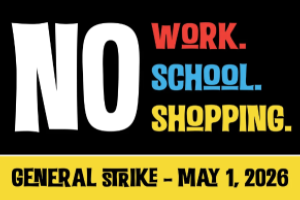
When emails about May Day 2026 started arriving a few weeks ago, suggesting NO WORK. NO SCHOOL. NO SHOPPING, my first thought was: “We’re not ready for that. Not as a country, and not locally. ”
In speaking to friends and neighbors, I heard the personal versions of my concerns:
- “I can’t afford not to work”
- “I don’t want to take my kid out of school”
- “Even if we wanted to strike we don’t know how”
- “My job involves helping immigrants. If I don’t work, that actually makes things worse”
To relieve my own confusion, I started reading about the goals of this year’s May Day. What I learned surprised me. I found out that the national organizations promoting May Day 2026 hope that many people won’t work, attend school or shop on May 1st, but they expect that this will be a work in progress. In other words, rather than expecting the American people to magically mount a successful national strike with no prior experience, they know that this is more of a practice run.
They have set clear goals – NO WORK. NO SCHOOL. NO SHOPPING. – so people know what they are aiming toward. No doubt some Americans will stay home from work or school and will not shop. However, the percentages will likely be fairly low compared to what would be needed to shut the country down. And that is where May Day 2026 is leading us – toward our collective capacity to shut down the functioning of the United States as a means of saying, “Our government’s egregious actions must stop. We will engage in collective action until those responsible are no longer in power. ”
And that is where May Day 2026 is leading us – toward our collective capacity to shut down the functioning of the United States as a means of saying, “Our government’s egregious actions must stop. We will engage in collective action until those responsible are no longer in power. ”
You might ask, “Why would we want to shut down the country? That seems like a terrible idea. ” Prior to January 2025, you would be right. However, as many of us are aware, our leaders have rapidly transformed our government from a weak but still functioning democracy into a competitive authoritarian regime. Many U.S. residents realize that we no longer live in a true democracy. Instead, we have a government with hollowed out democratic institutions and a facade of electoral fairness (hence the term “competitive” authoritarianism).
For most people (certainly, for me) this is a shocking place to find oneself – living in a country governed by individuals who do not represent us, who misuse their power, and who are hell-bent on keeping the power they have, no matter what that takes. Achieving a strong democratic congressional win across the board in the 2026 midterms is a crucial step toward turning things around, or what is called a Democratic U-turn.
But a Democratic U-turn will not happen without a major collective effort on our part. We need to use all the tools of noncooperation at our disposal to:
- ensure free and fair elections
- support Democratic and progressive landslides, and
- see that winners are acknowledged and seated in a timely fashion
The people of the United States need to be ready to see each of these outcomes through. Because each is being threatened by the current administration, we must be prepared to act if and when the time comes. And when the time comes, the most effective tactics will not be protests, but noncooperation tactics, such as strikes, boycotts, sit-ins and walkouts. As Ezra Levin, Co-Executive Director of Indivisible has said, “The next major national action isn’t another protest – it’s flexing our collective economic muscle.”
There is one problem with this plan. As a country, we are not ready for the type of nationwide mobilization required to achieve our goals. This is where May Day 2026 comes in.
May Day is the first widely-publicized effort to try out a day of noncooperation as a country. It is our opportunity to learn what we are ready for now and to understand the gaps we need to fill to be prepared for the November midterms. May Day 2026 is being used as what organizers call a structure test – a planned action that is both an action in itself as well as a learning opportunity.
May Day as a structure test asks a range of questions. How many people are ready to refrain from work, school and shopping now? For those who aren’t ready, what are their concerns? What types of support do they need to feel able to do these things? Who are the natural leaders ready to help their communities become increasingly ready to push back? These and more questions are being explored between now and the weeks following 5/1/26. With the answers to these questions, a new day of action will be set and communities across the U.S. will be asked to have a day of noncooperation once again. The cycle of information gathering will repeat itself and then on Labor Day 2026 there will be another day of action.
May Day as a structure test asks a range of questions. How many people are ready to refrain from work, school and shopping now? For those who aren’t ready, what are their concerns? What types of support do they need to feel able to do these things? Who are the natural leaders ready to help their communities become increasingly ready to push back?
It is important to note that, while this is a nationwide initiative, the heart of May Day is local. The success of the days of collective noncooperative action relies on individual communities coming together, getting to know each other better, and deciding together how they wish to engage in this national effort. When community members discover their own untapped energy and potential, not only for taking action together but for caring for one another and making decisions as a group with shared interests, there is no limit to what can happen.
While something like a national strike can feel to many like being forced to do something by some external entity, in this context — this unprecedented situation— it means ordinary American people coming together as communities and deciding how they want to say “No More – We Reclaim Our Power” in their own neighborhoods. This means how we support one another if many of us take a day off to strike. How we support our students who want to practice walking out. How we support our local businesses while boycotting big corporate stores. And how we learn together, develop resilience, and build noncooperative muscle through practicing increasingly substantial actions together.
So, while May Day has old roots (with origins including a Labour Day starting in 1793), and has been celebrated annually, May Day 2026 has a special role to play. The U.S. has never seen the type of rapid democratic backsliding that we’ve experienced over the last two years. And while ordinary Americans live with its effects daily, the actions of our democratic-turned-authoritarian government affects the entire world in profoundly harmful and dangerous ways, with no clear end in sight.
The U.S. has never seen the type of rapid democratic backsliding that we’ve experienced over the last two years. And while ordinary Americans live with its effects daily, the actions of our democratic-turned-authoritarian government affects the entire world in profoundly harmful and dangerous ways, with no clear end in sight.
We, as ordinary Americans – with our jobs and mortgages and stresses and busy lives – are the ones who can change where our country is headed. One of us can’t do it alone. Even 100 or 1,000 of us can’t. But, community by community, as we learn how to make these acts of noncooperation our own (e. g. , strikes, boycotts etc.), we can start reaching numbers like we saw progressively in the No Kings protests. 5 million. 7 million. 8+ million. And because we will be stepping on this metaphorical escalator with our neighbors and friends, our numbers can grow more quickly. As we move past 12 million to 15 and 20 million Americans, we will begin to reclaim our rightful place as the fourth branch of government – The People. Those who decide which direction this country will go. Because We The People founded this country expressly to live lives free of Tyrants.
As you consider whether or how you will participate in May Day 2026, remember that there is a long history of ordinary Americans who used collective noncooperative action to fight injustice. Prior to the American Revolution, colonists used homespun (i.e. non-British) cloth and boycotted British tea to undermine British profits. The Underground Railroad built alternative institutions that undermined the effectiveness of the Fugitive Slave Acts. The 1930s rent strikes of New York City made evictions unprofitable and logistically impossible, paving the way for modern rent control laws and state-funded housing relief. Bus boycotts and lunch-counter sit-ins in the 1950s and 60s broke through longstanding segregation practices and led to formal legislation in support of civil rights.
Like us, these people had regular lives. They worked hard and had families and friends they cared about. They read books, had pets, pursued hobbies, and had dreams for their future. And, like us, they felt extremely frustrated with the people in power at the time. As ordinary people, they coordinated with their friends and neighbors – their religious communities and social networks. And they decided that they had the wherewithal as a group to put their frustration into action. In doing that, they shaped history.
We are the next iteration of the American noncooperation movement. We have things to learn, but so did our predecessors. Learn the basics of noncooperation through Freedom Trainers. Explore step-by-step ways of moving toward a strike with Strike Ready Corp. Learn about the effectiveness of noncooperation from expert Erica Chenoweth, PhD. Learn about the Pillars of Support model. When you come together with your community, and communities come together across the nation, you’ll find out you have a lot more power than you realized.
Let’s turn our country around. Together. Starting on 5/1.
May Day 2026 in Medford – Here’s what you can do:
- Register for Medford May Day 2026
- Get and wear a May Day Medford sticker (Send your mailing address to info@mysticmashup.org)
- Get coffee, breakfast or lunch at these local venues and pay with cash
- Attend Noncooperation 101 – Learn which strategies are most effective in restoring fragile democracies like ours (1:30-2:30 PM, Medford Public Library, Bonsignore Hall, 2nd floor)
- Join the Boycott Citizens Bank Standout (4:00-5:00 PM in Medford Square) More info at https://www.mysticmashup.org/events/#citizens and https://www.boycottcitizens.org
- March with Medford down to Clippership Park (5:30-6:00 PM) Meet at 1 Riverside Drive and walk to Pop-Up Park
- Speeches, Potluck dinner and Music at Pop-Up Park (6:00 PM, 75 Riverside Avenue)
General May Day 2026 Resources:
- Boston May Day (4:30-6:30 PM, Boston Common)
- No Kings – What’s Next? (8:00 PM, March 31, Online) We showed up. And it mattered. But these days of action are not enough. Stay tuned for chances to flex our collective power.
- May Day Strong Website
Learn more about noncooperation:
- Freedom Trainers
- Strike Ready Corp
- Civil Resistance: What Everyone Needs to Know By Erica Chenoweth
- Beautiful Trouble
Gratitude to CM for helping me understand the importance of noncooperation in this historic moment.